
October 14, 2025


Customer experience is often discussed in terms of websites, apps, emails, and online support. Yet many impressions of a business still form away from a screen. A package arriving at someone's home, a conversation with an employee, or a printed welcome kit can influence how customers judge the entire company. Businesses that measure digital interactions while ignoring these offline moments may miss important sources of customer satisfaction and frustration.

Digital experiences happen quickly. Customers can place an order in minutes, receive an automated confirmation, and track its progress online. The physical experience has to support the expectations created during that process.
Consider an ecommerce purchase that arrives late, damaged, or in packaging that is difficult to open. The website may have worked perfectly, but the customer is unlikely to separate the delivery experience from the company that accepted the order. If you sell online, our guide to packaging for ecommerce versus retail covers what to weigh.
Physical locations work the same way. Parking, signage, cleanliness, wait times, and employee interactions all contribute to a customer's impression before and after a transaction. Our article on strengthening customer loyalty through exceptional experiences explains why those details matter.
Print still has practical uses throughout the customer journey. Welcome packets can explain services to new clients. Appointment reminders can reach customers who overlook email. Product instructions can reduce confusion after a purchase.
Companies may also use direct mail fulfillment services to coordinate printed customer communications, particularly when campaigns involve large mailing lists, multiple versions, or scheduled distributions.
Print should have a specific purpose. Sending customers material they do not need adds expense and creates clutter. A useful piece answers a question, communicates relevant information, or gives the recipient a clear reason to keep it.
A customer may research a business online and complete most of the buying process digitally, but one conversation with an employee can still shape the final impression.
That makes frontline staff an important offline touchpoint. Employees need access to enough customer information to continue the experience without forcing someone to repeat details already submitted online.
For example, a customer who schedules an appointment through a website should not arrive and discover that the location has no record of the requested service. Connecting digital records with frontline workflows reduces that type of friction.
Digital channels produce convenient metrics such as clicks, conversions, abandonment rates, and response times. Offline experiences can be harder to quantify, but they should not disappear from customer reporting.
Businesses can examine store wait times, delivery exceptions, product returns, call reasons, event attendance, mailed offer responses, and customer complaints. Surveys can also ask specifically about individual stages of an experience rather than requesting a broad satisfaction score.
Combining these signals with digital data can reveal problems that isolated systems miss. A rise in online support requests, for instance, might actually originate with unclear printed instructions included with a product.
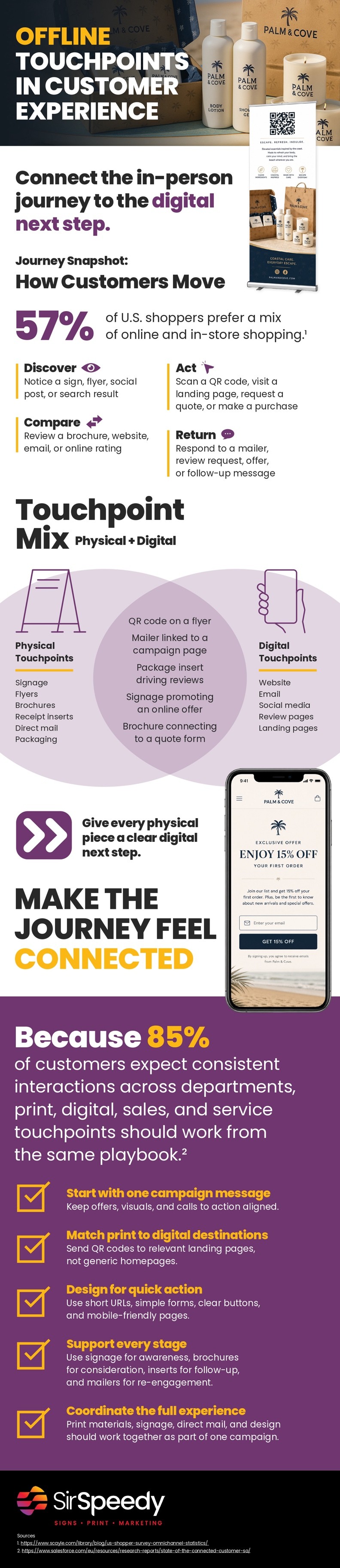
Customer experience does not end where digital tracking stops. Deliveries, printed communications, physical spaces, and employee conversations can reinforce or undermine everything that happens online. Look over the infographic below for more information.
Any interaction away from a screen, including deliveries, packaging, printed materials, physical locations and conversations with employees.
Customers rarely separate the delivery or in-person experience from the company that accepted the order.
When it answers a question, communicates relevant information or gives the recipient a clear reason to keep it. Unneeded mail adds expense and clutter.
Look at store wait times, delivery exceptions, product returns, call reasons, event attendance, mailed offer responses and customer complaints.
Hidden causes. A rise in online support requests, for example, may come from unclear printed instructions included with a product.