
November 17, 2025


Warehouse congestion slows operations, increases labor costs, and raises the risk of errors or injuries. As order volumes grow and delivery timelines tighten, crowded facilities become a serious operational barrier. Fixing congestion requires a mix of layout evaluation, process improvement, and smarter coordination across the supply chain.


Congestion rarely affects the entire warehouse equally. It usually starts in specific zones such as receiving docks, pick aisles, packing stations, or outbound staging areas. Bottlenecks form when material flow exceeds the capacity of people, equipment, or space.
Time studies, heat maps, and staff feedback help pinpoint problem areas. Understanding when congestion occurs, whether during peak shifts or specific order types, allows leaders to focus resources where they matter most.
Many warehouses operate with layouts that no longer match current demand patterns. High-volume items placed too far from packing stations or near narrow aisles increase traffic and delays. Re-slotting fast-moving products closer to outbound areas reduces travel time and congestion.
Wider aisles, one-way traffic flows, and clearly marked zones improve movement for forklifts and pedestrians. Vertical storage solutions can also free up floor space, allowing smoother circulation without expanding the facility footprint.
Congestion often spikes when inbound and outbound activity overlaps without coordination. Poor dock scheduling leads to trucks waiting, pallets stacking up, and staff scrambling to manage space.
Staggered appointment times, clearer unloading priorities, and real-time dock visibility help keep traffic flowing. Aligning inbound receipts with labor availability prevents backups before they spread across the warehouse.
Inefficient picking methods contribute heavily to congestion. Batch picking, zone picking, or wave picking can reduce unnecessary movement depending on order profiles. Separating bulk and small-item workflows prevents slower processes from blocking faster ones.
Technology plays a key role in congestion reduction. Warehouse management systems provide visibility into inventory location and task assignments, helping staff avoid conflicts and idle time.
Upstream coordination also matters. Integrating warehouse operations with transportation management software improves shipment timing, load planning, and carrier coordination. When outbound schedules align with warehouse capacity, congestion at staging areas decreases.
Congestion increases when labor and equipment are mismatched. Too few forklifts or pallet jacks force workers to wait, while too many operators in a small area create traffic jams.
Flexible staffing models, cross-training, and clear task prioritization help maintain balance. Equipment placement should support flow rather than convenience, ensuring tools are available where activity peaks.
Short-term fixes provide relief, but lasting improvement requires planning for future demand. Seasonal spikes, new product lines, or e-commerce growth all affect space and flow.
Regular layout reviews and process audits ensure the warehouse evolves alongside the business. Small adjustments made consistently prevent congestion from returning at larger scale.
Warehouse congestion is a sign that operations have outgrown existing systems. By addressing layout, scheduling, and coordination together, businesses can support growth without constant firefighting. Look over the infographic below for more information.
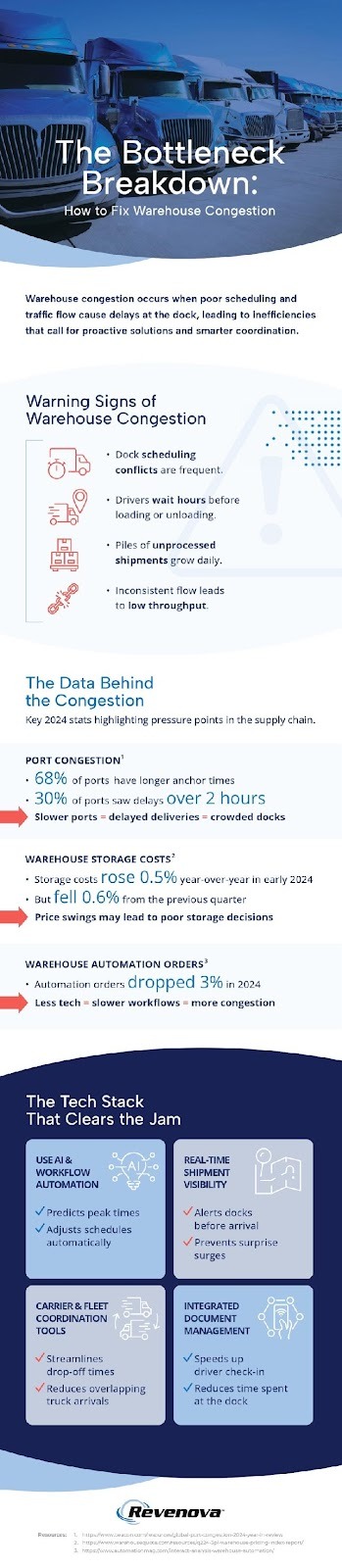
Your first step is to identify where the congestion begins. It's rarely a problem across the entire facility. Focus on specific zones like receiving, packing, or staging areas by using heat maps, time studies, and direct feedback from your team to find the root cause.
Re-evaluating your layout can have a huge impact. By moving your fastest-selling products closer to shipping areas, creating one-way traffic flows, and using vertical storage, you can reduce travel time and free up floor space for smoother movement.
Poor dock scheduling is a primary cause of bottlenecks. When inbound and outbound trucks arrive without coordination, it creates logjams. Staggering appointments and ensuring you have the staff ready for incoming shipments keeps materials moving instead of piling up.
Technology is key for better coordination. A Warehouse Management System (WMS) gives you real-time visibility into inventory and tasks, helping you direct staff efficiently. Solutions from providers like Beacon Inside help sync your warehouse operations with transportation, preventing backups before they start.
The goal is balance, not just more of one or the other. Having too few forklifts makes people wait, while too many operators in one area creates its own traffic jam. A flexible staffing model and ensuring equipment is placed where it's needed most is the best approach.