October 23, 2025


Effective leadership isn’t one-size-fits-all, it’s about understanding yourself and those you lead. That’s where DISC personality styles come in. The DISC abbreviation breaks down into four areas: D – Decisive, I – Interactive, S – Stabilizing, and C – Cautious. We are all a blend of these four. The DISC test categories highlight which tendencies show up most strongly for each individual. Understanding these styles gives leaders a clear framework for motivating teams, resolving conflicts, and communicating more effectively.

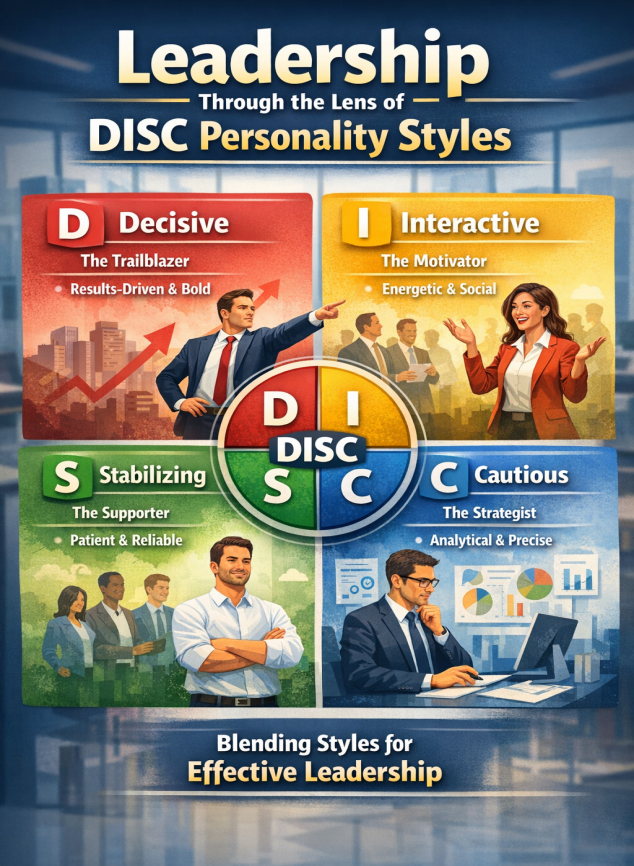
Every leader brings a unique blend of strengths and challenges to their role. The DISC model, originally developed by William Moulton Marston, helps decode those differences by focusing on behavioral tendencies, how people act, not just what they think.
By identifying your DISC type, you gain insight into your leadership habits: how you make decisions, delegate tasks, and interact with your team. Below, we explore how each DISC personality style influences leadership in distinct ways.
Leaders with strong D traits are action-oriented and results-driven. They thrive in fast-paced environments and make quick decisions. Their direct communication and confidence inspire others, but they may need to slow down and consider others’ input more carefully.
Leadership tip: Balance your drive for results with empathy and patience when guiding your team.
Style leaders bring energy and enthusiasm to their teams. They motivate through recognition, positivity, and charisma. Their natural people skills help create an inspiring workplace culture, though they may sometimes overlook details or structure.
Leadership tip: Pair your enthusiasm with clear follow-through to turn excitement into execution.
Leaders high in S are steady, dependable, and team-focused. They excel at building trust and maintaining harmony. Their calm approach makes them approachable and reliable, yet they may resist sudden change.
Leadership tip: Embrace adaptability and encourage constructive feedback to strengthen team resilience.
C-style leaders value accuracy, organization, and logic. They make thoughtful, data-driven decisions and set high standards for themselves and others. However, perfectionism or over-analysis can slow progress.
Leadership tip: Learn when “good enough” is better than “perfect” to keep momentum strong.
Most successful leaders aren’t purely one type, they balance elements from multiple DISC personality styles. For example, a D/I leader combines decisiveness with people skills, while an S/C leader blends empathy with structure. Recognizing your mix helps you adapt your approach to different personalities and situations.
Integrating DISC insights into leadership development can transform workplace culture.
When leaders apply the principles of DISC personality styles, they move from managing people to truly leading them, with empathy, awareness, and precision.
Leadership is both art and strategy, and DISC provides the language to master both. By seeing through the lens of DISC personality styles, leaders can connect more authentically, communicate more clearly, and inspire teams to perform at their best.
The four styles are Decisive (D), Interactive (I), Stabilizing (S), and Cautious (C). Each represents a primary behavioural tendency. D-styles are direct and results-focused, I-styles are enthusiastic and persuasive, S-styles are supportive and dependable, and C-styles are analytical and precise.
If you have a strong 'D' style, you can improve by consciously slowing down to consider your team's input. Balancing your natural drive for quick results with empathy and patience will help you build a more collaborative and motivated team.
The main advantage is their ability to motivate. 'I' style leaders use their natural charisma, positivity, and people skills to create an energetic and inspiring workplace culture where team members feel recognised and valued.
No single style is perfect for every situation. Successful leaders blend elements from multiple styles to adapt their approach. For example, combining a 'D' style's decisiveness with an 'S' style's empathy creates a balanced leader who can drive results while supporting their team.
You can begin by introducing the DISC framework in leadership development programmes. Using it for team-building activities, conflict resolution training, and one-on-one coaching helps everyone understand different communication styles. Resources from providers like Beacon Inside can guide this integration process effectively.